
PDRN Skincare Guide · Absorption
Does PDRN cream absorb into the skin?
How much truth is there in the claim that PDRN is “low molecular weight, so it absorbs deeply”? Drawing on published sources, we look at how the skin barrier is built and how big PDRN really is, then map out where the PDRN you apply ends up.
The short answer
The stratum corneum, the outermost layer of healthy skin, does not readily let through substances with a molecular weight above 500 daltons (Da). According to its certificate of analysis, the PDRN raw material PYDERIN uses averages 150 bp, which works out to about 97 kDa (97,000 daltons) by weight. That is roughly 194 times the threshold.
So it’s reasonable to conclude that most of the PDRN you apply stays on the skin’s surface and in the upper layers of the stratum corneum.
Sinking in is not the same as absorption
A minute or two after you apply a cream, the shine fades and the slippery feel under your fingertips disappears. People often call this fast absorption, but what is mostly happening is that the water in the formula evaporates and the remaining ingredients spread into a thin film on the skin. The feeling that a product has sunk in is one thing; “penetration,” where an ingredient passes through the stratum corneum and moves farther down, is another.
This distinction is also the starting point for judging the claim “low molecular weight, so it absorbs deeply.” What gets in, and how much, depends on the structure of the skin and the size of the molecule.
The stratum corneum is built like a brick wall
The stratum corneum, the skin’s outermost layer, is about 10–20 µm thick: one-tenth to one-fifth the thickness of a sheet of copy paper (about 0.1 mm). It is thin but tightly built. Flattened, hardened skin cells called corneocytes are stacked in many layers, and the gaps between them are filled with lipids made up of ceramides, cholesterol and fatty acids. The cells are often likened to bricks and the lipids to the mortar between them, and it is mainly these lipids that act as the barrier keeping water from escaping.1
Substances from outside have three main routes through this layer: a winding path through the lipids between the corneocytes, a direct path straight through the cells and a path down the hair follicles. Most ingredients take the first route.1 That path is only nanometers wide and oily in character, so small molecules that dissolve reasonably well in both water and oil get through easily, while large or strongly charged molecules do not.
The 500 Dalton rule of thumb
In 2000, Dutch dermatology researchers Bos and Meinardi drew attention to a common thread: substances that cause allergic reactions on contact with the skin, drugs applied to the skin and drugs delivered through skin patches almost without exception have a molecular weight below 500 daltons. They named this the “500 Dalton rule.”2
Despite the name, it is really a rule of thumb drawn from observation. Around 500 daltons, the outcome depends on the properties of the ingredient and the formula, and it also varies with the condition of the skin. Still, the overall pattern, that intact skin becomes sharply harder to cross as molecules get bigger, is widely accepted in dermatology. Pharmaceutical science likewise holds that delivering large molecules through the skin takes special techniques to get past the stratum corneum barrier.3
Molecular weight of common cosmetic ingredients (log scale)
Because the scale is logarithmic, the bars look close in length, but the real differences in size are far larger. Drawn to scale, they look like this:
Picturing 97 kDa
PDRN is a mix of DNA fragments of varying lengths, so no single molecular weight can be quoted for it; it is described by an average instead. The certificate of analysis for PYDERIN’s raw material lists an average size of 150 bp (base pairs). In double-stranded DNA, each base pair weighs about 650–660 daltons, so 150 bp comes to about 97–99 kDa. The 97 kDa figure PYDERIN gives for its products is 97.5 kDa, calculated at 650 daltons per base pair and rounded down.4
Pictured as a shape, it is a thin rod about 2 nm across and about 50 nm long, since the DNA double helix grows 0.34 nm longer with each base pair. DNA of this length behaves much like a stiff rod, and the phosphate groups in its backbone give it a strong negative charge and make it very water-loving. That is almost exactly the opposite of the profile we saw earlier for molecules that pass easily through the stratum corneum.
So is “low-molecular-weight PDRN” an accurate description? It depends on the yardstick. The research literature usually describes PDRN as a mixture of DNA fragments with molecular weights of 50–1,500 kDa, and one classification puts fragments under 50 kDa in a separate low-molecular-weight PDRN group.5 By that classification, an average of 97 kDa sits at the small end of the usual PDRN range. By any yardstick, though, it is a very large molecule next to 500 daltons, the threshold for the skin barrier. When you see “low molecular weight,” first check what it is being compared with.
Where applied PDRN stays
Taken together, the evidence indicates that most of the PDRN you apply remains on the skin’s surface and in the upper layers of the stratum corneum. DNA is a large, water-loving molecule, so it has a hard time working its way into the narrow, oily paths through the lipids.
What about hair follicle openings?
Studies have found that dyes and fine particles applied to the skin collect in hair follicle openings and stay there for a while,6 and the forehead, where follicles are most densely packed, has relatively more of this space.7 However, we found no study in human skin confirming that PDRN stays in follicle openings in this way.
What matters when you apply it
Molecular size is the starting point, but other variables also change the outcome. The amount that passes through the skin is proportional to the difference in concentration between the outside and the inside of the skin, and the same ingredient behaves differently depending on the formula it is in and how hydrated the skin is.8 The tips below help what you apply spread evenly and stay on the skin longer. They are not ways to push PDRN into the skin.
Products spread more evenly when your skin is still damp, such as right after cleansing or after toner. Finishing with a cream reduces water loss and helps your skin stay hydrated for longer. Studies have found that covering the skin (occlusion) often increases how much of an ingredient penetrates,9 but most of those results involve small molecules, so they can’t simply be extended to a large molecule like PDRN.
Don’t exfoliate on the same day you try a new product for the first time: right after exfoliating, a new product is more likely to sting. Avoid using cosmetics on broken skin, and if you are seeing a doctor for a skin condition, check with your doctor before using cosmetics.
Why PYDERIN discloses size and purity
PYDERIN discloses its 97 kDa and 99% purity figures because they can be checked against the certificate of analysis. PDRN raw materials can differ in size distribution and level of purification from one supplier to another, so a stated average size and purity give you a basis for comparing which raw material was used. The certificate for PYDERIN’s raw material records an average size of 150 bp, 99% DNA purity, an A260/A280 ratio of 1.78 (a gauge of whether protein is mixed in) and no detectable levels of four heavy metals. The 97 kDa figure in PYDERIN’s product information is a representative value, converted to weight from this lot’s measurement; the raw material’s specification calls for an average of 30–200 kDa. We explain what each of these unfamiliar numbers measures in How to read the numbers on a PDRN label.
How a cream feels and how well it moisturizes depend largely on the ingredients that come with the PDRN. REJUVUSTER PDRN Rejuvenating Cream, for example, lists moisturizing ingredients such as panthenol, ceramide NP and squalane alongside its PDRN. We look at what each ingredient contributes in Ingredients to use with PDRN.
-
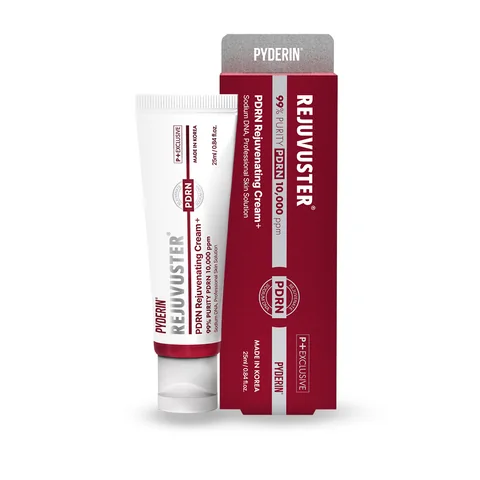 REJUVUSTER · Partner pharmacies (Korea)
REJUVUSTER PDRN Rejuvenating Cream
A cream combining 97 kDa PDRN with panthenol, ceramide NP and squalane
View product
REJUVUSTER · Partner pharmacies (Korea)
REJUVUSTER PDRN Rejuvenating Cream
A cream combining 97 kDa PDRN with panthenol, ceramide NP and squalane
View product
-
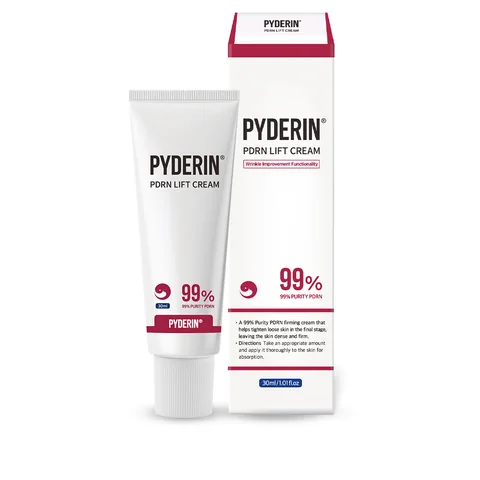 PYDERIN · Partner clinics (Korea)
PDRN Lift Cream
A cream that adds panthenol, 7 types of collagen and acetyl hexapeptide-8 to PDRN. The ingredient list includes fragrance
View product
PYDERIN · Partner clinics (Korea)
PDRN Lift Cream
A cream that adds panthenol, 7 types of collagen and acetyl hexapeptide-8 to PDRN. The ingredient list includes fragrance
View product
-
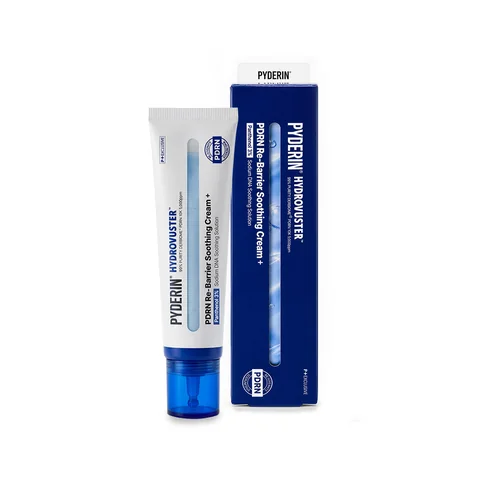 HYDROVUSTER · Partner pharmacies (Korea)
PYDERIN HYDROVUSTER PDRN Re-Barrier Soothing Cream
A cream with 3% panthenol, ceramide NP and squalane alongside PDRN
View product
HYDROVUSTER · Partner pharmacies (Korea)
PYDERIN HYDROVUSTER PDRN Re-Barrier Soothing Cream
A cream with 3% panthenol, ceramide NP and squalane alongside PDRN
View product
Frequently asked questions
Does PDRN cream reach the dermis?
There is no evidence that it does. We found no study in human skin confirming that PDRN averaging 97 kDa passes through the stratum corneum of healthy skin and reaches the dermis.
Is low-molecular-weight PDRN absorbed better than high-molecular-weight PDRN?
Most low-molecular-weight PDRN is still far larger than 500 daltons, so being “low molecular weight” is not, on its own, a reason to think it gets into the skin. When you compare PDRN ingredients, the average size tells you something about the raw material, but size alone doesn’t determine how a product feels or what it does.
If it isn’t absorbed deeply, what’s the point of a PDRN cream?
In cosmetics, PDRN appears on ingredient lists as Sodium DNA, and the Korea Cosmetic Industry Association (KCIA) ingredient dictionary gives its function as “skin-conditioning agent.”10 In PYDERIN creams, it is used together with moisturizing ingredients such as panthenol and squalane to care for the skin’s surface and stratum corneum. In Korea, benefits such as wrinkle improvement or brightening may be claimed only by products reviewed or reported as functional cosmetics (a Korean regulatory category), and only within that scope.
When should I apply PDRN cream?
Use it at the cream step, after cleansing and any toner or serum, while your skin is still damp. In the morning, finish with sunscreen. Avoid broken skin.
References
These sources cover the skin barrier, molecular size and ingredient definitions. They are not studies of PYDERIN finished products.
- Elias PM. Epidermal lipids, barrier function, and desquamation. J Invest Dermatol. 1983;80(1 Suppl):44s–49s. doi:10.1038/jid.1983.12
- Bos JD, Meinardi MM. The 500 Dalton rule for the skin penetration of chemical compounds and drugs. Exp Dermatol. 2000;9(3):165–169. doi:10.1034/j.1600-0625.2000.009003165.x
- Prausnitz MR, Langer R. Transdermal drug delivery. Nat Biotechnol. 2008;26(11):1261–1268. doi:10.1038/nbt.1504
- QIAGEN. Working with DNA: good laboratory practice. Molecular weight calculation for double-stranded DNA (662 daltons per base pair, as the sodium salt). qiagen.com
- Marques C, Porcello A, Cerrano M, et al. From polydeoxyribonucleotides (PDRNs) to polynucleotides (PNs): bridging the gap between scientific definitions, molecular insights, and clinical applications of multifunctional biomolecules. Biomolecules. 2025;15(1):148. doi:10.3390/biom15010148
- Lademann J, Knorr F, Richter H, et al. Hair follicles – an efficient storage and penetration pathway for topically applied substances. Skin Pharmacol Physiol. 2008;21(3):150–155. doi:10.1159/000131079
- Otberg N, Richter H, Schaefer H, et al. Variations of hair follicle size and distribution in different body sites. J Invest Dermatol. 2004;122(1):14–19. doi:10.1046/j.0022-202X.2003.22110.x
- Scheuplein RJ, Blank IH. Permeability of the skin. Physiol Rev. 1971;51(4):702–747. doi:10.1152/physrev.1971.51.4.702
- Zhai H, Maibach HI. Effects of skin occlusion on percutaneous absorption: an overview. Skin Pharmacol Appl Skin Physiol. 2001;14(1):1–10. doi:10.1159/000056328
- 대한화장품협회 화장품 성분사전 [Korea Cosmetic Industry Association (KCIA), Cosmetic Ingredient Dictionary]. 소듐디엔에이 (Sodium DNA): origin and definition, “sodium salt of DNA”; function, “skin-conditioning agent.” kcia.or.kr
This article is general information to help you choose and use cosmetics. It is not a substitute for the diagnosis or treatment of any condition. If you have a skin problem, consult a dermatologist.