
PDRN Skincare Guide · Raw materials and names
PDRN, PN and Sodium DNA: what’s the same and what’s different?
Some products highlight PDRN and others PN, yet on the ingredient list both often show up as Sodium DNA. Here is why one family of ingredients goes by several names, and how to check where a raw material comes from, which the name alone won’t tell you.
The short answer
PDRN and PN are both names for DNA fragments, and they are told apart mainly by fragment size. A review paper published in 2025 proposed a molecular weight of 1,500 kDa as the dividing line: fragments smaller than that would be called PDRN, and those of 1,500 kDa or more, PN.
On cosmetic ingredient lists, both appear under ingredient names such as Sodium DNA or Hydrolyzed DNA, so the name tells you neither the size nor the source. You have to check each separately: size from a kDa or bp figure, and source from origin information.
- Left · PDRNA mixture of short DNA fragments of varying lengths
- Right · PNLonger, continuous DNA chains
How the three names connect
PDRN is short for polydeoxyribonucleotide. Deoxyribonucleotides are the basic building blocks of DNA, and the prefix “poly-” means that many of these units are linked together. In practice, the raw material called PDRN is a mixture of DNA fragments of varying lengths. PN is short for polynucleotide; it is used for the longer, larger chains of the same kind of DNA.
Cosmetic ingredient lists usually use neither name. Instead, they use ingredient names such as Sodium DNA, meaning the sodium salt of DNA, or Hydrolyzed DNA, meaning DNA broken into smaller pieces by hydrolysis. In September 2026, when Korea’s Ministry of Food and Drug Safety (MFDS) announced the results of its inspection of PDRN cosmetics advertising, it described PDRN as “low-molecular-weight DNA fragments of animal or plant origin, such as salmon or roses” and noted that in cosmetics the ingredient is labeled under names like these.1 “Low molecular weight” here means that long DNA has been cut into smaller pieces, not that the pieces are small enough to pass through the skin. We cover the link between size and absorption in Does PDRN cream absorb into the skin?
| Name | What it refers to | Size information |
|---|---|---|
| PDRNpolydeoxyribonucleotide | A mixture of DNA fragments of varying lengths | Often 50–1,500 kDa in the research literature |
| PNpolynucleotide | DNA chains longer than PDRN | One proposal puts it at 1,500 kDa and above |
| Sodium DNAOn Korean labels: 소듐디엔에이 | Cosmetic ingredient-list name; the sodium salt of DNA | The name carries no size information |
| Hydrolyzed DNAOn Korean labels: 하이드롤라이즈드디엔에이 | Ingredient-list name for DNA broken into smaller pieces by hydrolysis | The name carries no size information |
Where the size line is drawn
There is still no single agreed line between PDRN and PN. The research literature often describes PDRN as a mixture of DNA fragments with molecular weights of 50–1,500 kDa, but recent reports describe everything from very small fragments of around 1 kDa to large chains of up to 10,000 kDa, and the two names are now used inconsistently. To clear up the confusion, a 2025 review paper proposed 1,500 kDa as the dividing line: anything smaller would be PDRN, and anything 1,500 kDa or larger would be PN. The same paper also describes earlier work that classified fragments smaller than 50 kDa as low-molecular-weight (low-MW) PDRN.2 Keep in mind that this is one research group’s proposal rather than a standard agreed on across the field.
Converting to base pairs (bp) makes this easier to picture. At about 650 daltons per base pair, 1,500 kDa is about 2,300 bp and 50 kDa is about 77 bp. The raw material PYDERIN uses has an average molecular weight specification of 30–200 kDa, and the measured value for the published lot is an average of 150 bp (about 97 kDa). Under this proposal, it falls on the small side of the usual PDRN range.
Names by DNA fragment size (log scale, kDa)
Why ingredient lists say Sodium DNA
Under Korean labeling rules, the ingredient list on cosmetic packaging uses standardized ingredient names, and a raw material made by blending several ingredients is listed not under its own name but ingredient by ingredient.3 If a PDRN raw material is DNA dissolved in water, for example, the ingredient list shows water and Sodium DNA separately instead of “PDRN.”
That makes PDRN less an ingredient-list name than a term for the kind of raw material. The Korea Cosmetic Industry Association (KCIA) advises that raw-material names used in product descriptions should ideally match the ingredient-list names, and that other names may be given alongside them.4 Writing both names together, as in “Sodium DNA (PDRN),” makes it easier for consumers to find the ingredient on the list.
Same name, possibly different sources
The name Sodium DNA describes only the chemical form of the DNA, not where it came from. Today most PDRN raw material is obtained from the sperm cells of fish in the salmon family, mainly chum salmon and rainbow trout, because sperm cells are a good source of DNA with few impurities such as proteins and lipids.2
There are other sources too. DNA from marine organisms such as starfish and sea cucumbers, from algae such as red algae (laver) and from plants such as ginseng has been studied,2 and recombinant raw materials made by culturing microorganisms have also appeared. A supplier of recombinant raw materials also notes that salmon-derived and recombinant materials can both appear as Sodium DNA on ingredient lists.5 Different sources can mean different purification methods, size distributions and quality control, so if you want to know the source, check whether the brand publishes origin and raw-material information separately.
How to check the source of salmon raw material
For salmon PDRN, there are three things to check.
- Country and species. See whether the brand goes beyond “salmon-derived” and names the country where the raw material was extracted and the scientific name of the species. Chum salmon is Oncorhynchus keta; rainbow trout is Oncorhynchus mykiss.
- Certificate of analysis. Check whether it includes the average size and its specification, purity and heavy-metal test results. We explain how to read these numbers in How to read the numbers on a PDRN label.
- Ingredient list and content. See whether Sodium DNA is on the ingredient list and whether its finished-product content is stated with it.
The certificate of origin for the PDRN raw material PYDERIN uses states: “This product is extracted from salmon (Oncorhynchus keta) testis or semen in Republic of Korea.” This means it was extracted in the Republic of Korea from the testis or semen of chum salmon; it does not say where the salmon were caught. In Korea, chum salmon is the species people usually just call “salmon.”
-
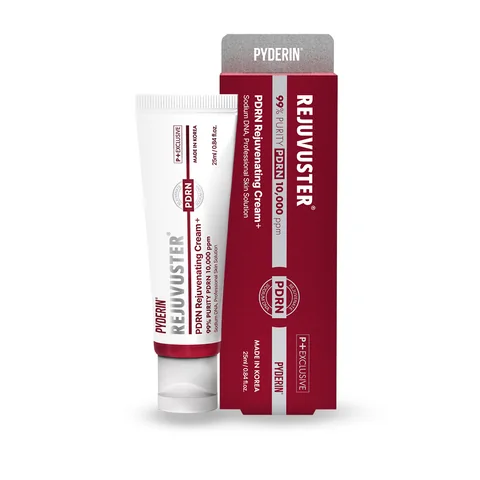 REJUVUSTER · Partner pharmacies (Korea)
REJUVUSTER PDRN Rejuvenating Cream
A cream whose product information states 99% purity and 97 kDa PDRN. On the ingredient list, it appears as Sodium DNA
View product
REJUVUSTER · Partner pharmacies (Korea)
REJUVUSTER PDRN Rejuvenating Cream
A cream whose product information states 99% purity and 97 kDa PDRN. On the ingredient list, it appears as Sodium DNA
View product
-
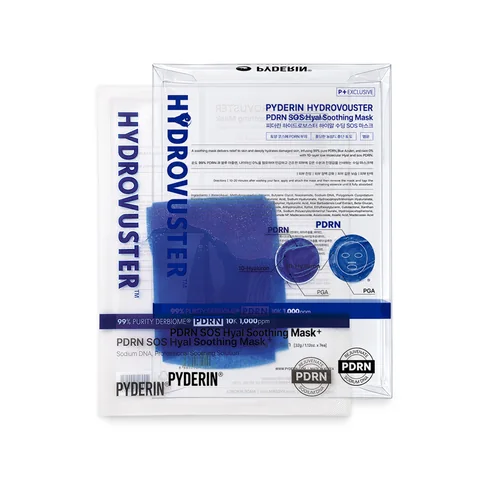 HYDROVUSTER · Partner pharmacies (Korea)
PYDERIN HYDROVUSTER PDRN SOS Hyal Soothing Mask
A mask whose product information gives the raw material by its trade name, DERBIOME® PDRN 10K. It also contains 10 types of hyaluronic acid and PGA
View product
HYDROVUSTER · Partner pharmacies (Korea)
PYDERIN HYDROVUSTER PDRN SOS Hyal Soothing Mask
A mask whose product information gives the raw material by its trade name, DERBIOME® PDRN 10K. It also contains 10 types of hyaluronic acid and PGA
View product
-
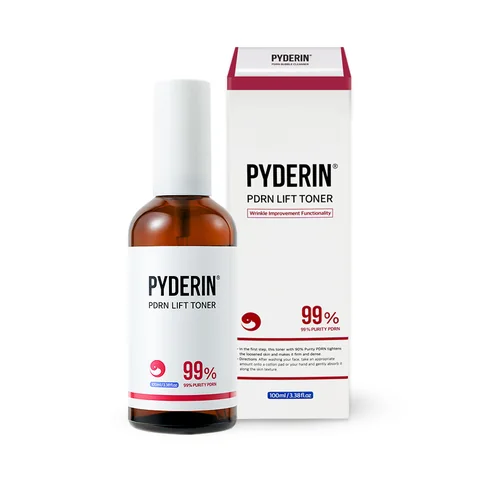 PYDERIN · Partner clinics (Korea)
PDRN Lift Toner
An essence toner that adds panthenol and 8 types of hyaluronic acid to 99% purity, 97 kDa PDRN
View product
PYDERIN · Partner clinics (Korea)
PDRN Lift Toner
An essence toner that adds panthenol and 8 types of hyaluronic acid to 99% purity, 97 kDa PDRN
View product
Frequently asked questions
Is PN a better ingredient than PDRN?
They differ in size; neither can simply be called the better ingredient. When choosing a cosmetic, the stated size, the finished-product content and the other ingredients give you a more accurate picture than the name.
Are salmon PDRN and plant PDRN the same ingredient?
Both are DNA, but purification methods and size distributions can differ by source. Since they may share an ingredient-list name, check the origin and raw-material information separately.
How is salmon PDRN raw material made?
DNA is extracted from salmon testis or semen, purified to remove other substances such as proteins, and then the fragments are brought to the target size. Size is checked with methods such as electrophoresis, and protein contamination with the absorbance ratio.
I have a fish allergy. Can I use salmon PDRN cosmetics?
Proteins are removed from PDRN raw material during purification, but no one can guarantee that there will be no allergic reaction. If you have a fish allergy, talk to your doctor before using these products. If your doctor says it’s fine to use them, first apply the product to a small area such as the inside of your arm twice a day for 7–10 days, and use it on your face only if no reaction appears.6
References
These sources cover terminology, labeling rules and raw-material sources. The origin of PYDERIN’s raw material is taken from its certificate of origin.
- Ministry of Food and Drug Safety (MFDS), Korea. Press release 「가족 건강을 위한 추석 선물 고를 땐 반드시 확인하세요」 [Check carefully when choosing Chuseok gifts for your family’s health] (includes the results of an inspection of improper PDRN cosmetics advertising). 2026 Sep 17. mfds.go.kr
- Marques C, Porcello A, Cerrano M, et al. From polydeoxyribonucleotides (PDRNs) to polynucleotides (PNs): bridging the gap between scientific definitions, molecular insights, and clinical applications of multifunctional biomolecules. Biomolecules. 2025;15(1):148. doi:10.3390/biom15010148
- 화장품법 시행규칙 [별표 4] 화장품 포장의 표시기준 및 표시방법(3. 화장품 제조에 사용된 성분) [Enforcement Rule of the Cosmetics Act, Annex 4: Labeling standards and methods for cosmetic packaging (3. Ingredients used to manufacture the cosmetic)]. Korea Cosmetic Industry Association (KCIA), laws and regulations. kcia.or.kr
- Korea Cosmetic Industry Association (KCIA). 화장품 성분사전 자주 묻는 질문(전성분 명칭과 원료 명칭 표기) [Cosmetic Ingredient Dictionary FAQ (ingredient-list names and raw-material names)]. kcia.or.kr
- Onuoha C. Same INCI, different origins: why PDRN sourcing matters. Cosmetics Business. 2026 Sep 3. A promotional article (labeled Promoted Content) featuring Uniproma, a maker of recombinant PDRN raw materials. cosmeticsbusiness.com
- American Academy of Dermatology. How to test skin care products. aad.org
This article is general information to help you understand cosmetic ingredient names and raw materials. If you have allergies or a skin problem, talk to a doctor before use.